AMD has officially introduced the new Ryzen AI 400 Series, expanding its AI focused processor lineup into the desktop PC market for the first time. The new chips bring the Ryzen AI brand beyond laptops and into desktop systems built on the AM5 socket.
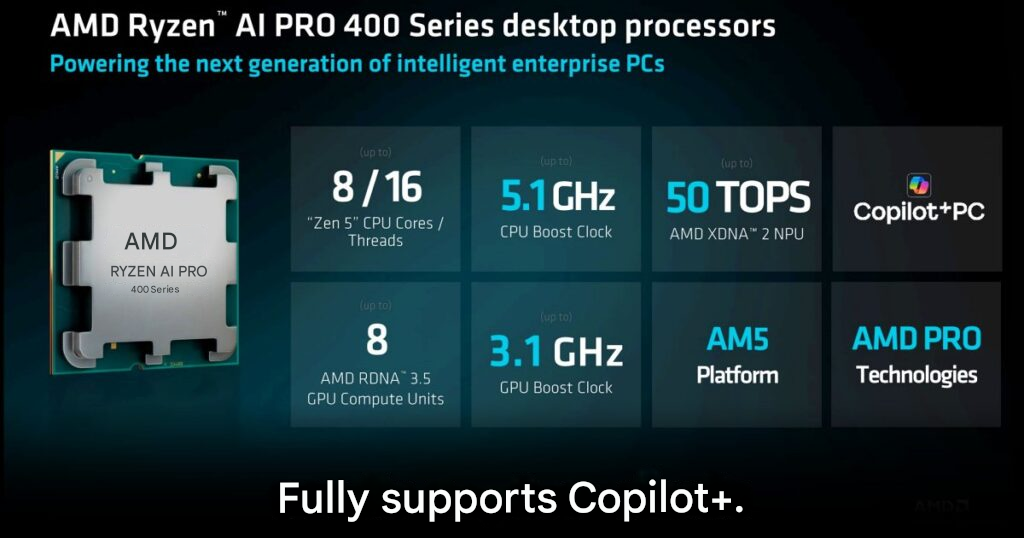
The processors combine several modern technologies including the latest Zen 5 cores, integrated graphics based on RDNA 3.5, and a dedicated neural processing unit designed for advanced AI workloads.
AI performance designed for the Copilot+ PC era
A major highlight of the Ryzen AI 400 Series is its dedicated neural processing unit capable of delivering 50 TOPS of AI performance. This level of compute allows the processors to meet the requirements for Copilot+ PC systems from Microsoft.
With this capability, desktops using the chips can unlock AI features in Windows 11 such as Recall and Click to Do. These features rely on strong local AI processing to run models directly on the device.
Running AI workloads locally improves speed and data privacy. It also allows organizations to run large language models and AI powered applications without relying on cloud servers.
Ryzen Pro models target business systems
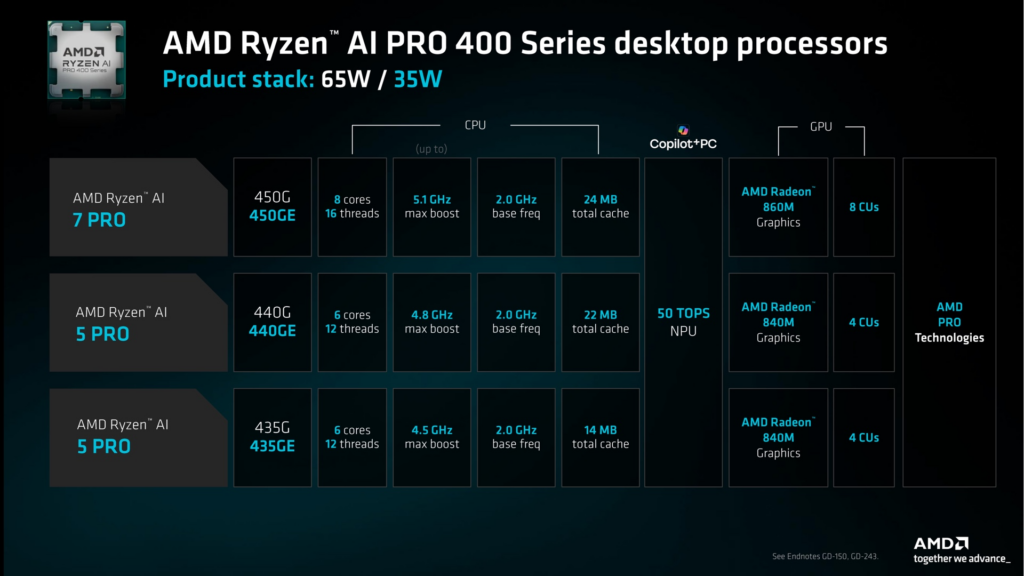
For the initial launch, AMD is focusing on enterprise and business customers. The lineup introduces six processors under the Ryzen Pro branding.
The top model in the lineup is the Ryzen AI 7 Pro 450G with eight CPU cores. Other options include the Ryzen AI 5 Pro 440G and the Ryzen AI 5 Pro 435G. AMD also offers energy efficient GE variants that operate at just 35 watts of power.
These processors are designed for office desktops and mini PCs that do not require a dedicated graphics card but still need strong graphics and AI capabilities.
Integrated graphics and multimedia performance
The integrated graphics solution in the flagship model uses Radeon 860M graphics with eight compute cores. While it is not the highest tier GPU in AMD’s mobile lineup, the RDNA 3.5 architecture still delivers solid performance for everyday graphics workloads.
This includes tasks such as video editing, content creation, and media processing. The integrated GPU is designed to provide enough power for productivity without the need for a discrete graphics card.
Initial availability through OEM systems
Although the Ryzen AI 400 Series targets desktop systems, AMD will initially distribute the chips through prebuilt computers rather than the DIY market.
Major OEM partners such as HP and Lenovo are expected to release systems powered by the processors first. This approach allows AMD to deliver optimized enterprise solutions that include security and management tools powered by AMD PRO technologies.
Another factor influencing this strategy is the current price of DDR5 memory. Systems relying on integrated graphics require fast memory to achieve the best performance, which can increase the cost for custom builds.
Prebuilt business PCs powered by the Ryzen AI 400 Series are expected to start appearing in the market during the second quarter of 2026. Entry level enterprise systems may begin at around $670, while higher specification models could reach around $1,250.
With AI workloads becoming increasingly important in modern computing, AMD’s move into desktop AI processors signals a major step toward making AI acceleration a standard feature in everyday PCs.
Origin: Arstechnica