Valve urges users to upgrade to 64-bit systems
Beloved PC gaming platform Steam is preparing to say goodbye to another piece of legacy technology. Valve has officially announced plans to discontinue support for 32-bit versions of Windows, with the change taking effect on January 1, 2026. The announcement was published on Steam’s official support website, where Valve explained that this move is necessary to enable future feature development that relies on more modern drivers and libraries.
Currently, Steam only supports Windows 10 and above. Since Windows 11 has never offered a 32-bit version, Windows 10 (32-bit) is now the last operating system capable of running Steam in a 32-bit environment and it is rapidly approaching the end of its lifecycle. As a result, Valve’s decision is seen as a step toward improving overall software performance and long-term stability.
Looking back, Microsoft itself stopped distributing 32-bit versions of Windows 10 to OEM partners back in 2020. This means that users who purchased new PCs in recent years are highly unlikely to be running a 32-bit system. The remaining users are typically those on much older machines or specialized setups that have not yet modernized their software environments.
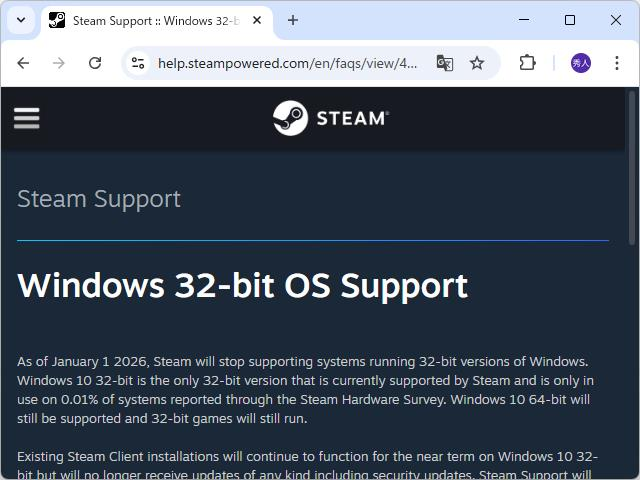
According to Valve’s latest Steam Hardware Survey, only around 0.01 percent of global users are still running Windows 10 in 32-bit mode. With such a small user base affected, Valve is confident that ending support will not cause widespread disruption, while also serving as a clear signal for this remaining group to begin transitioning forward.
Valve’s advice to users still on 32-bit systems is straightforward: upgrade to a 64-bit version of Windows as soon as possible. After the cutoff date, Steam running on unsupported systems will no longer receive security updates, potentially leading to stability issues or the client ceasing to function entirely posing risks to both usability and personal data security.
That said, gamers don’t need to panic. Even though the Steam client itself will become fully 64-bit, older games in players’ libraries that were originally built as 32-bit applications will continue to run normally on 64-bit versions of Windows thanks to system-level compatibility layers. In short, the only task for users now is to ensure their Windows environment is upgraded to 64-bit in time.
Source: Forest Watch