
Google Android Bench ranks the best AI models for Android coding
The Android development ecosystem is entering a new era as Google officially introduced Android Bench, a benchmark designed to evaluate how well AI models can assist with Android application development.
Unlike traditional coding benchmarks, Android Bench focuses on real-world developer challenges. The tests measure how effectively AI systems handle tasks that Android developers face every day.
These include building user interfaces using Jetpack Compose, writing asynchronous code with Kotlin Coroutines, and managing modern development patterns such as dependency injection and SDK updates.
Why Google created Android Bench
Google explained that existing AI coding benchmarks do not fully reflect the complexity of Android development.
Android developers often need to manage complicated project structures, including Gradle configuration files, navigation systems, and compatibility across multiple device types.
The platform must also support emerging technologies such as foldable displays and advanced camera systems.
Android Bench was created to measure which AI models can truly help developers solve these practical problems and improve productivity when building high-quality mobile applications.
Gemini 3.1 Pro takes first place
According to the benchmark results, Gemini 3.1 Pro Preview secured the top position with a score of 72.4 percent, demonstrating strong understanding of Android’s development ecosystem.
Second place went to Claude Opus 4.6, which achieved 66.6 percent.
Third place was claimed by GPT‑5.2 Codex, scoring 62.5 percent.
These models proved capable of handling complex development tasks such as dependency injection systems and SDK migration more effectively than other AI tools tested in the benchmark.
Mid-tier and lightweight models
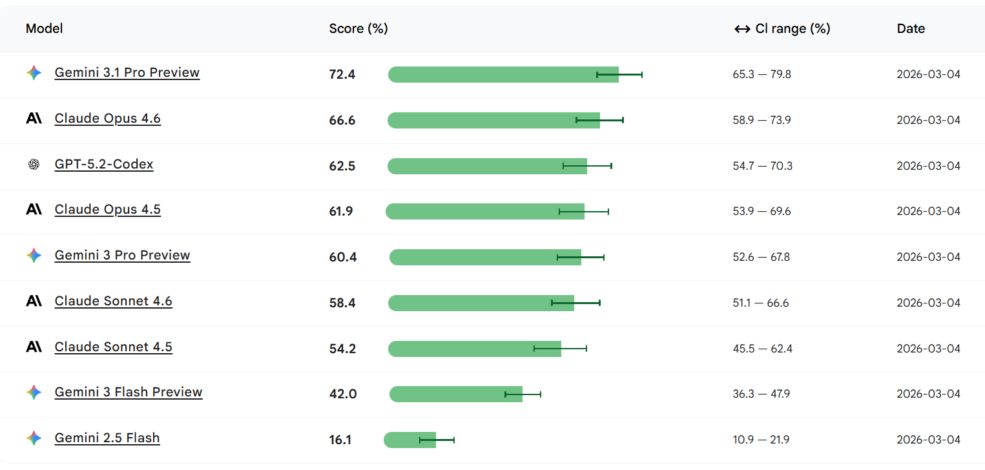
Several other models also performed well, though with slightly lower scores.
Claude Opus 4.5 and Gemini 3 Pro Preview both scored slightly above 60 percent, showing solid capabilities for coding support.
Meanwhile, faster lightweight models such as Claude Sonnet 4.6 and Claude Sonnet 4.5 landed in the mid-range with scores between 54 and 58 percent.
At the lower end of the ranking, Gemini 2.5 Flash scored only 16.1 percent, suggesting that smaller models may struggle with complex Android development tasks.
AI as a developer assistant
Google emphasized that the goal of Android Bench is not to replace developers but to improve the tools available to them.
By publishing these results, the company hopes to encourage AI developers to improve their models so they can better support Android programming.
For developers, choosing AI tools that perform well in Android Bench could significantly improve productivity. Tasks such as managing Room Database, handling security features, and maintaining large app architectures can become faster and less error prone.
Ultimately, better AI development tools should lead to higher quality apps with fewer bugs and smoother user experiences.
Origin: 9to5google