Google is expanding its tools for checking whether online content is real, edited, or generated by AI.
The company is bringing stronger transparency and verification features across Search, Gemini, Chrome, Pixel smartphones, and Google Cloud.
As AI-generated images, videos, and audio become harder to identify with the naked eye, users need better ways to understand where digital content came from.
SynthID becomes the main tool
The biggest part of Google’s effort is SynthID.
This invisible digital watermark technology has been developed for more than 3 years.
It embeds hidden signals into AI-generated content in a way humans cannot see.
Google says SynthID has already been applied to more than 100 billion images and videos.
It has also been used across audio files totaling more than 60,000 years in length.
Content Credentials support expands
Google is also working with the C2PA alliance to support Content Credentials.
This global standard helps show how a file was created and edited.
It can help users check whether an image came directly from a camera or was modified with creative tools.
Pixel 10 will be the first smartphone to include this system directly inside its camera app.
Google also plans to update Pixel 8, Pixel 9, and Pixel 10 devices with video support in the coming weeks.
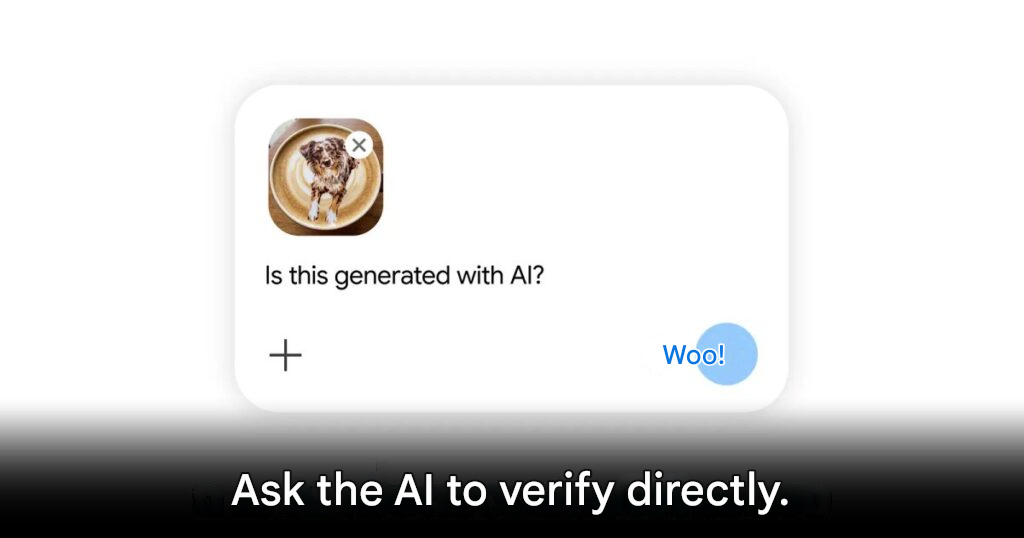
Gemini can now check AI-generated images
Google has added SynthID detection into the Gemini app.
The feature has already been used 50 million times worldwide.
Google will also expand this detection ability into Search and Chrome in the coming weeks.
That means users may soon be able to check suspicious images through Lens, AI Mode, Circle to Search, or by asking Gemini inside Chrome.
More media checks are coming
Google has also started adding C2PA Content Credentials checks into Gemini.
This allows the system to detect whether an image appears to be an untouched camera photo or has been edited with specific tools.
The same feature will later expand to Search and Chrome.
This works similarly to AI labels on YouTube and the Backstory testing system for digital media verification.
Google works with major AI partners
Since online content often spreads across many platforms, Google is not working alone.
The company is working with major names such as OpenAI, Kakao, and ElevenLabs to bring SynthID to content created by their models.
Google has also open-sourced watermarking code for text.
It is also working with NVIDIA to embed watermarks into videos generated by the Cosmos model.
Instagram, which is part of the C2PA steering committee through Meta, is also preparing to label Content Credentials for real camera photos.
This means photos taken with supported Pixel cameras may later show labels confirming they came from a real camera when shared on Instagram.
Enterprise tools for AI content detection
Google is also launching a new AI Content Detection API through the Gemini Enterprise Agent Platform on Google Cloud.
This tool helps companies detect AI-generated content from Google and other popular AI models.
Businesses can use it to organize news feeds, prevent insurance fraud, or verify content before publication.
THIS IS our take
Google is moving in the right direction because AI detection cannot stay hidden inside specialist tools. If users can check suspicious images through Search, Chrome, Gemini, Lens, and Pixel cameras, digital transparency becomes much easier for everyone.
SOURCE: https://blog.google
This Is Game SEA