Anthropic Opus 4.8 Launches with Dynamic Workflows

Anthropic has officially released Opus 4.8, which the company now positions as its most advanced AI model.
The new model is available worldwide at the same standard price as the previous version. That makes the update especially notable because it arrives only 41 days after Opus 4.7. This is a much faster upgrade cycle than what users usually see from the Sonnet or Haiku model families.
This quick release suggests that Anthropic may be moving aggressively to strengthen its top-tier model lineup, especially as the AI market becomes more competitive.
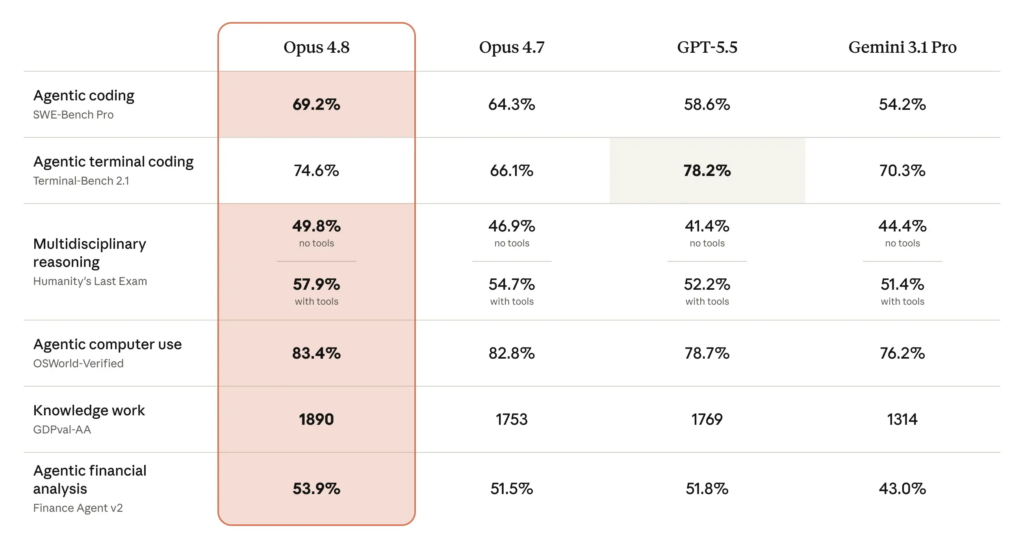
Anthropic moves quickly after Opus 4.7
The timing of Opus 4.8 is one of the most interesting parts of the launch.
According to the original report, the previous Opus 4.7 release did not receive the strongest market response. At the same time, rivals continued to increase pressure. OpenAI released Codex, while Google pushed forward with Gemini Flash.
With competition rising quickly, Anthropic appears to be improving model performance at a faster pace to maintain its user base and stay relevant in a fast-changing AI landscape.
For users who rely on top-end AI models for coding, data analysis, research, and complex problem solving, faster upgrade cycles could become a major advantage.
Opus 4.8 improves uncertainty handling
The biggest improvement in Opus 4.8 is not only benchmark performance.
The more important change is how the model handles unclear or incomplete information. Early testers said Opus 4.8 is better at warning users when it is unsure about an answer.
This matters because one of the biggest problems with AI tools is overconfidence. A model may sometimes provide a confident response even when its answer lacks enough supporting data.
With Opus 4.8, Anthropic aims to reduce that issue. The model reportedly lowers the chance of creating unsupported claims and gives clearer signals when information may need extra checking.
For professional users, that could be more valuable than raw speed alone. A smarter AI assistant should not only answer quickly. It should also know when to slow down, ask for better inputs, or warn users about possible uncertainty.
Bridgewater highlights better data alerts
Bridgewater Associates, one of the groups that tested the model in real workflows, reportedly noticed a clear difference in how Opus 4.8 handles incoming data and analysis results.
According to the original article, Bridgewater said the model can better flag potential issues before they become larger problems. This includes warning users about possible trouble in input data or in the result of an analysis.
That type of behavior can help reduce errors in serious work. Many AI models can generate output, but users still need to inspect whether the input was flawed, whether the conclusion was weak, or whether the model missed something important.
If Opus 4.8 can identify those risks earlier, it could become more useful for teams working with complex data.
Dynamic Workflows enters Research Preview
Alongside the new model, Anthropic also introduced Dynamic Workflows as a Research Preview feature.
This tool is designed to help large models like Opus manage complex tasks by directing hundreds of sub-agents at the same time.
One example mentioned in the original article involves working with Claude Code to migrate massive codebases from start to finish. This could involve hundreds of thousands of lines of code, making it far too complex for a simple one-step instruction.
With Dynamic Workflows, the AI can break large jobs into smaller pieces, assign work across many sub-agents, and coordinate the process more effectively.
For software teams, this could become a major step toward AI-assisted engineering at larger scale.
Mythos remains under wraps for now
Anthropic’s highly anticipated top-tier Mythos model is still being held back.
According to the original article, early testing last month raised cybersecurity safety concerns. Because of this, Anthropic has not released the model to general users yet.
However, the company hinted that safety system development is progressing well. If work continues smoothly, users may get access to Mythos within the next few weeks.
That means Opus 4.8 may serve as an important bridge before Anthropic’s next major leap.
Opus 4.8 feels like an important release because Anthropic is focusing on reliability, not only raw intelligence. Better uncertainty handling, fewer unsupported claims, and stronger alerts around weak data could make the model more useful for serious work. Dynamic Workflows is also worth watching because it points toward AI systems that can manage large, multi-step projects instead of only answering prompts. If Anthropic can keep improving speed, safety, and reliability together, it may stay competitive against OpenAI and Google in the next phase of AI tools.
Origin: Techcrunch