The handheld gaming PC market is about to get more competitive.
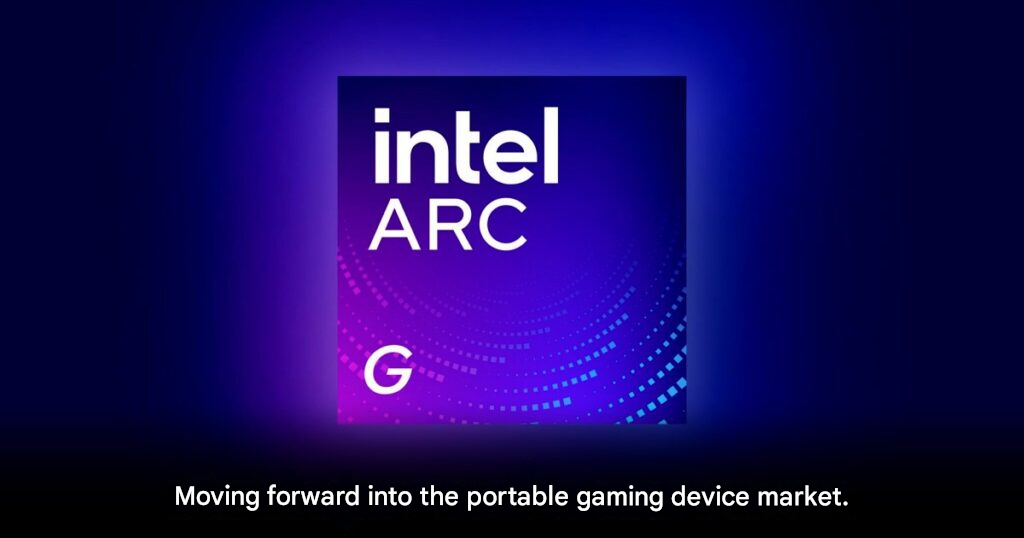
After years of seeing AMD-powered chips dominate many portable gaming devices, Intel is now stepping into the arena with its newly introduced Arc G-Series processors. These chips are designed specifically for handheld gaming machines, bringing Intel’s Arc graphics power into compact gaming hardware.
The goal is clear. Intel wants to offer gamers a stronger alternative in a market that continues to grow quickly across PC-style handheld devices.
Intel Arc G-Series targets handheld gaming PCs
The new Arc G-Series is built to bring the performance of Intel’s Arc B-Series GPU family into portable devices.
This is important because handheld gaming PCs need a careful balance between performance, power efficiency, heat control, and battery life. A chip may look powerful on paper, but it still needs to run well inside a smaller device with limited cooling.
Intel’s move could open a new chapter for players who want more options beyond the current AMD-heavy handheld gaming space.
New devices are expected from major brands
Players can expect new handheld gaming devices using Intel’s new chips starting June 2026.
Several major hardware names are already involved. MSI is expected to introduce a new version of its Claw handheld, while Acer is preparing the Predator Atlas 8. OneXPlayer is also expected to release a new device using the latest Intel hardware.
What makes this launch interesting is Intel’s use of the Arc name for the full chip identity, not only for the graphics side. This suggests that Intel wants Arc to become a stronger brand for gaming-focused portable hardware.
Arc G3 and Arc G3 Extreme lead the lineup
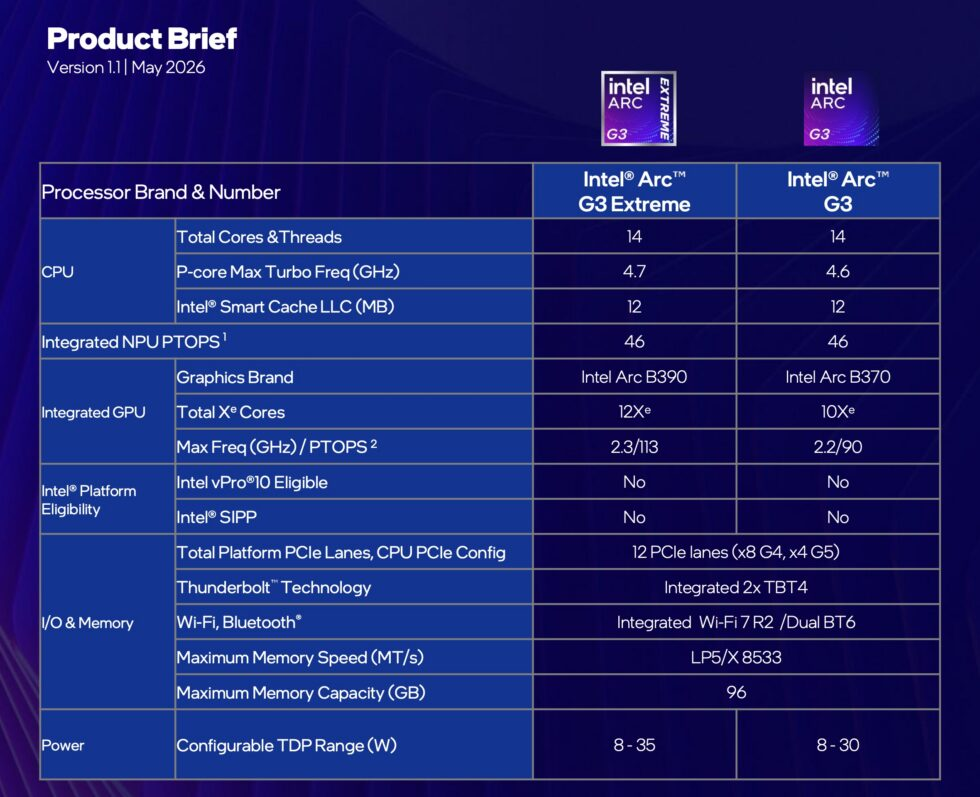
The new lineup includes Arc G3 and Arc G3 Extreme.
These chips are said to be close to Core Ultra Series 3, also known by the codename Panther Lake. This architecture is connected to high-end thin-and-light laptops and uses Intel’s advanced 18A process.
Both chips come with a 14-core CPU layout. This includes P-cores, E-cores, and LP E-cores, allowing the system to manage power more intelligently depending on the task.
For handheld gaming devices, that kind of power management matters because players need both performance and efficiency.
Arc B390 and B370 handle the graphics side
The biggest difference between the 2 versions comes from the GPU.
The Arc G3 Extreme includes Arc B390 graphics with 12 Xe cores. Meanwhile, the standard Arc G3 uses Arc B370 graphics with 10 Xe cores.
Both versions also include an NPU powerful enough to support Copilot+ features on Windows 11. This means devices using these chips may not only work as gaming handhelds, but also as more complete portable PCs.
Players could use them for desktop-style work, AI-assisted Windows features, media, browsing, and other PC tasks when connected to a monitor, keyboard, or dock.
Intel may challenge AMD in handheld gaming
Early testing mentioned in the original article suggests that Arc B390 can perform up to 2 times faster than AMD’s Radeon 890M in some situations.
However, real-world handheld performance will still depend on heat management, power limits, battery life, and how each manufacturer designs its device. A chip’s maximum performance may not always translate perfectly into a compact handheld body.
Even so, Intel’s newer graphics architecture gives the company a serious chance to challenge AMD in the long run.
If the first wave of Arc G-Series handhelds performs well, players may soon have more variety when choosing between portable gaming PCs.
SteamOS support may become possible later
For players hoping to see Intel-powered handhelds running SteamOS, there may be a reason to stay hopeful.
The current official focus appears to be Windows 11. However, the original article notes that preview versions of SteamOS have started improving support for Intel chips.
This does not mean full SteamOS support is ready immediately. More optimization may still be needed. Still, it suggests that Intel-powered handheld gaming devices could eventually become more flexible for players who prefer Valve’s operating system.
THIS IS our take
Intel’s move into handheld gaming with Arc G-Series is important because the market needs more competition. AMD has been the safer and more familiar choice for many handheld gaming PCs, but Intel now seems ready to fight seriously in this space. The real test will not only be raw power. It will be heat, battery life, driver stability, and actual game performance in portable form. If Intel can deliver on those points, the next generation of handheld gaming PCs could become much more exciting for players.
This Is Game SEA