Introduction
OpenAI has officially introduced GPT-5.6, its latest generation of artificial intelligence models designed to handle complex tasks with greater intelligence, speed, and efficiency.
The update focuses on stronger contextual understanding, more accurate responses, and more natural interactions. OpenAI officially launched the GPT-5.6 family on July 9, 2026, describing it as a major improvement in intelligence gained from each processed token.
Stronger Reasoning and More Accurate Analysis
One of GPT-5.6’s most important improvements is its ability to understand complicated instructions and analyze information more effectively.
The model is designed to make fewer mistakes while maintaining context across longer and more demanding tasks. This should make its responses feel more consistent and natural, particularly when users are working through multi-step problems or detailed projects.
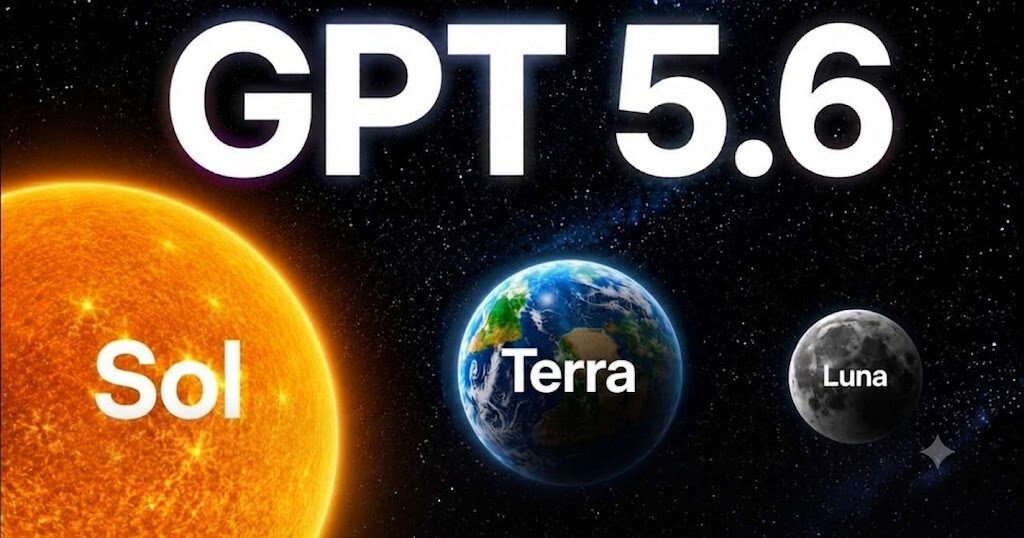
OpenAI says the GPT-5.6 family delivers stronger performance across coding, professional knowledge work, cybersecurity, science, and tool-based workflows. The flagship GPT-5.6 Sol model is positioned as the most capable option, while Terra and Luna provide more balanced and cost-efficient alternatives.
Built for Coding, Documents, and Professional Work
GPT-5.6 is intended to manage demanding tasks such as writing complex code, reviewing large collections of documents, analyzing information, and supporting business planning.
Its improved reasoning allows it to work through complicated assignments with less guidance. OpenAI also says the model can coordinate tools, process intermediate results, monitor progress, and determine which action to take next as a task develops.
These improvements could make GPT-5.6 particularly useful for developers, researchers, content creators, business professionals, and teams managing projects with multiple stages.
The model also offers stronger support for presentations, documents, spreadsheets, interface design, and other professional outputs. According to OpenAI, it can follow reference materials and established design systems more accurately than earlier models.
More Natural Conversations
The original report highlights improvements in GPT-5.6’s ability to recognize conversational tone, emotional context, and appropriate pacing.
These changes are intended to make interactions feel less mechanical. Rather than simply producing an answer, the model is designed to respond in a way that better reflects the user’s intention and the context of the ongoing conversation.
This could help GPT-5.6 function as a more effective working partner when users are brainstorming ideas, refining content, solving technical problems, or managing long-running assignments.
Greater Efficiency From Every Token
OpenAI has also placed considerable emphasis on efficiency. GPT-5.6 is designed to complete demanding work with fewer tokens, fewer repeated tool calls, and lower estimated costs than previous models in several evaluated workflows.
The company describes this as stronger performance per dollar, allowing users to complete more successful work for the same expenditure or achieve comparable results at a lower overall cost.
The Thai report also presents GPT-5.6 as a more resource-efficient system. However, OpenAI’s official announcement primarily discusses token usage, processing time, API costs, and computational efficiency rather than promising reduced hardware consumption on an individual laptop or smartphone.
Expanded Safety and Security Measures
As GPT-5.6 becomes more capable, OpenAI has introduced additional safeguards intended to reduce harmful or inappropriate use.
The company says GPT-5.6 underwent its most extensive evaluation process to date before general release. This included human red-team testing, automated evaluations, real-time monitoring, and layered protections designed to respond to emerging attacks and misuse.
OpenAI has also applied more stringent controls to higher-risk capabilities, particularly in cybersecurity and biological research. The company acknowledges that no security system is perfect and says it will continue updating safeguards as new weaknesses are discovered.
GPT-5.6 Availability
GPT-5.6 began rolling out globally across ChatGPT, Codex, and the OpenAI API on July 9, 2026.
Availability varies by platform and subscription level. Plus, Pro, Business, and Enterprise users can access GPT-5.6 Sol through supported reasoning settings, while Free and Go users can access GPT-5.6 Terra in ChatGPT Work and Codex. Developers can use Sol, Terra, and Luna through the OpenAI API.
OpenAI has also introduced different reasoning levels for users who need either faster everyday performance or greater computational effort for difficult tasks.
THIS IS our take
GPT-5.6 appears to be a meaningful advancement for users who depend on AI for coding, research, content production, design, and other complicated professional workflows. Its strongest practical improvements may come from better task completion, more disciplined tool use, and higher efficiency rather than conversational intelligence alone.
However, benchmark results and company demonstrations do not guarantee identical performance in every real-world situation. Users should evaluate GPT-5.6 based on their own workflows, especially when accuracy, confidentiality, or high-stakes decisions are involved.
w