Japanese Developers Discuss Why Japan Struggles to Make a Game Like Neverness to Everness
Japanese Developers Discuss Why Japan Struggles to Make a Game Like Neverness to Everness
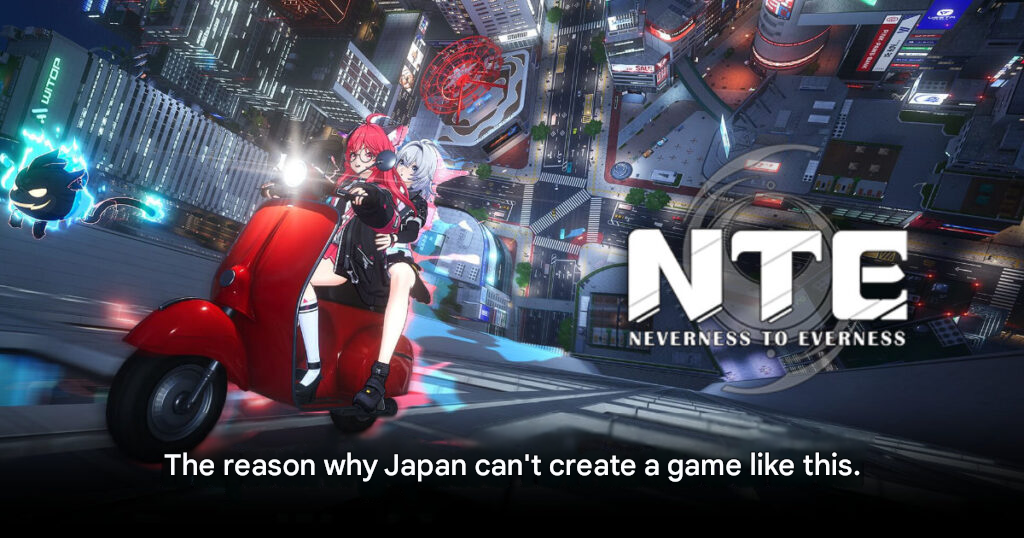
Neverness to Everness has quickly become one of the most talked-about anime-style open-world games of the year. Developed by Hotta Studio, the game launched on April 29 and reportedly generated more than 540 million baht in revenue, drawing attention not only from players but also from developers across the industry.
The game has also attracted strong interest from Japanese players, especially because its city environments appear heavily inspired by real-world urban locations such as Akihabara and Shibuya. For many fans, that detail has created a surprising contrast: a large-scale anime-style open-world game filled with familiar Japanese cultural influences was created by a Chinese studio, while Japan itself still has no game of similar quality and scale in the same space.
That question has now reached Japanese developers, some of whom have begun openly discussing why creating a game like Neverness to Everness is so difficult for the Japanese game industry.
Developers Point to the Technical Strength of Neverness to Everness
One of the voices that gained attention was Alwei from Indie-Us Games, a studio known for its Unreal Engine expertise. Since Neverness to Everness is built with Unreal Engine, Alwei shared thoughts on the technical strengths of the game and why a project like this would be extremely difficult to produce under Japan’s current development environment.
According to Alwei, anyone in the Japanese game industry who has played Neverness to Everness would likely understand how impressive its technical execution is. He pointed to the game’s level of detail and polish, saying that it feels far beyond what many would expect from a large open-world live-service anime title.
He explained that after climbing to the highest point in the city of Hethereau and comparing screenshots between the PC and iOS versions, he found that the game still ran smoothly with almost no noticeable stuttering. From a developer’s perspective, he described that level of performance as genuinely intimidating.
A City That Feels Alive, Not Randomly Built
Alwei also praised the design of Heterocity, saying it does not feel like a city assembled from random objects. Instead, the environment feels alive, with every object appearing to be active and intentionally placed.
He noted that strong performance on PC is understandable for a project of this level, but the surprising part is that the game can still run smoothly on mobile devices. For a title with this much content and detail, that level of optimization suggests an enormous amount of work behind the scenes.
In his view, Neverness to Everness is not impressive only because of its graphics or anime style. It stands out because it combines content volume, technical polish, and high-level optimization across multiple platforms.
Why Japan Would Struggle to Build the Same Kind of Game
When asked whether Japan could create something similar, Alwei gave a blunt answer: it would be nearly impossible under current conditions.
He explained that a game like Neverness to Everness requires specialists in every field, high-quality art production, and the ability to manage an enormous amount of development resources. All of this must happen at a very large scale.
He also pointed to Japan’s stricter labor regulations and overtime limitations as part of the challenge. With less available working time and tighter restrictions, reaching the same level of production speed and scale becomes extremely difficult.
Still, Alwei did not frame the issue as hopeless. He said that while it has become harder and harder to meet the rising expectations of players, he still believes there should be a “Japanese way” to approach this challenge. His message was not about giving up, but about continuing to search for a method that fits Japan’s own development culture.
Budget and Manpower Create a Major Gap
Another Japanese developer who joined the discussion was Ukyo, a game producer who wrote about the difference in executive decision-making and investment scale between Japan and other major Asian game markets.
Ukyo said he was shocked after working with a top Chinese studio, where a single project could have around 200 people constantly assigned just to character-related work, including modeling, movement, and animation. He added that this kind of scale is not limited to China, as major studios in South Korea also operate with similar production manpower.
By comparison, he said Japanese studios often struggle to get additional animation budgets approved. Finding enough skilled people for that type of work is also extremely difficult.
For Ukyo, the gap in both workforce size and financial power is one of the biggest reasons Japan and China currently differ so much in their ability to develop large-scale games.
The Cost of Making a Giant Open-World Game
Sean Noguchi from Electronic Arts Japan also shared a story that reflects the gap between ambition and budget expectations in the Japanese industry. He said a Japanese company once asked whether it would be possible to create a Japanese version of Grand Theft Auto with a budget of 500 million yen.
Noguchi said he laughed when he heard the question because a game on the scale of Grand Theft Auto would require at least 20 billion yen. His comment highlights one of the core issues in the debate: some companies may want globally competitive open-world games, but the budgets they imagine are far below what those projects realistically require.
Large open-world games demand massive investment in technology, art, animation, QA, localization, live operations, server infrastructure, and long-term content support. Without that level of investment, matching the scale of games like Neverness to Everness becomes extremely difficult.
Neverness to Everness Is Raising Player Expectations
Beyond the issues of manpower, budget, and industry structure, Neverness to Everness is also changing what players expect from anime-style live-service games. Its large city setting, smooth multi-platform performance, visual density, and polished presentation are placing new pressure on developers.
For Japanese studios, this means the challenge is no longer only about making good anime-style games. The market is now comparing those games against massive open-world projects that run across PC, console, and mobile, while also offering high production values and long-term live-service potential.
This pressure falls directly on developers, who must now think about whether Japan can eventually produce its own large-scale title in the same category.
A Free-to-Play Open-World RPG Across Multiple Platforms
Neverness to Everness is an anime-style open-world RPG set in a large urban environment. The game is available as a free-to-play title on PC through its official launcher, PlayStation 5, iOS, Android, and Mac.
Its rapid rise has made it more than just another new open-world game. For many developers and players, it has become a symbol of how quickly large-scale game development expectations are changing, especially in the anime-style live-service space.
Whether Japan can eventually create a game on the same scale remains an open question. What is clear for now is that Neverness to Everness has started a serious conversation about the future of Japanese game development, and whether the industry can adapt to a market where technical ambition, production scale, and global expectations are higher than ever.
Origin: automaton-media